Mami Sugar. Search no. 3: Rewriting
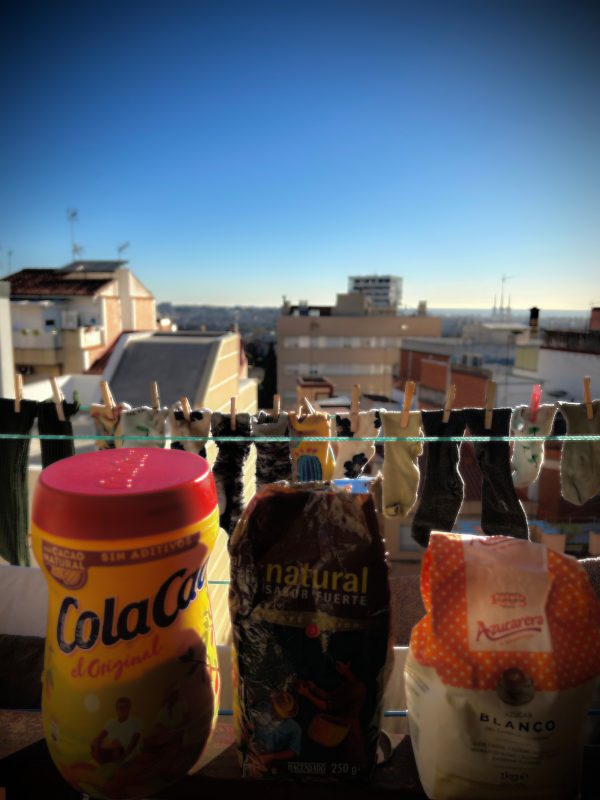
A sock: an everyday object, minimal, almost insignificant. When I look at it, I make an immediate association:
sock → foot → shoe
And this journey leads me to think about hundreds, thousands of people who walk:
- who cross deserts, coasts, cities and frontiers;
- who reach Europe or try to get to Catalonia;
- who disappear from our view as soon as they get to the city;
- who cannot go into museums, but sustain everyday life.
I think of those who live on the edges, about non-normative bodies that do not fit into the official narrative. I think of those, still without papers, who build and sustain the Catalan economy:
- the people in the fields in Lleida province,
- those who work in recycling with the same materials that Tàpies used to create his work.
Those invisible presences who are here; their ancestors felt the whip that helped to raise up this country with raw materials like cocoa, coffee, sugar and timber.
And if I think of Tàpies, I inevitably think of Catalonia. And if I think of Catalonia, is see the senyera, its flag. How would a Catalan flag be constructed today?
What is its gold? Whose is the blood behind the four red bars?
But I am Catalan. This flag is also mine. We need to appropriate the symbols, transform them, play with them, create new narratives.
This is another foundational story for the 21st-century Catalan flag, made from the socks of Afro-descendent people who walk over fictitious blood.
This is why I propose a different senyera: a flag created from the sidelines, from the bodies that are not expected in the street but are exhibited in the museum as a symbol of diversity and integration.
In this other flag, the yellow is the gold of Abya Yala: the wealth extracted from Africa and Latin America, today turned into coltan, cocoa, oil and extractive companies that sustain European well-being. The red is the blood of the transatlantic trade: a trail that lives on in the deaths in the Mediterranean, on the frontiers where black bodies continue to bleed.
Because the black presence in Catalonia does not begin with recent migration: it is ancient, it is in the land and in time.
In almost all regions of Africa there exists a figure that connects the worlds of the living and the dead. A presence that dresses in clothing made of dried leaves, of fibres, of cloths, of materials that breathe memory. It is a mask that entertains children, that dances, that provokes, but that also guides, supports and helps to transcend. A figure that does not just appear: it intercedes. That does not just dance: it opens gateways. That does not just play: it protects.
I want to take this ancestral figure and create one of our own; a being wearing socks, with the socks of people who migrate to Catalonia, and also the socks used to create this new flag.
Socks get lost in the wash, yes; but they are also the best place to keep secrets, to protect small treasures, to keep us from the cold in the world. This is why I ask the migrant community for these odd socks in order to create a suit to dialogue face to face with Tàpies’ giant sock; a suit to stir a dance of the marginalised, a movement to bring together times and places, to connect me to the thousands of people who walk, who make the crossing over to Europe, to Spain, to Catalonia. Because when there are no shoes, when all has been lost or left behind, we will carry on walking in socks.
My body—black, female, nearly fifty years old, fat, queer, excessive—is not the expected body. But it is this body that today constructs this new senyera. That claims its place in the narrative. That says: Catalonia is also written by us. That declares: we are here, we have always been here and we are a fundamental part of what this territory is and what it may become.
Silvia Albert Sopale
Silvia Albert Sopale is an actress by vocation, a director by obligation, a dramatist by social responsibility and an activist out of love for blackness. Born in San Sebastián, she is the daughter of a Boobe mother from Equatorial Guinea and an Igbo father from Nigeria. She currently lives in Barcelona.
She is founder of Periferia Cimarronas, the first Black theatre company in Spain; she taught the 2025 spring chair at the King Juan Carlos I of Spain Center at the University of New York; she is a member of the Academia de las Artes Escénicas de España; founder of Hibiscus, the association of Afro-Spaniards and Afro-descendants; and director of the Festival Black Barcelona. She is also co-founder of Tinta Negra, a collective promoting racial diversity in the performing arts, and member of t.i.c.t.a.c. (Taller de Intervenciones Críticas Transfeministas Antirracistas Combativas).
She is joint creator of No es país para negras (2014), Blackface y otras vergüenzas (2019), Parad de pararme (2021), La Moreneta (2021), Cuentos desde la Periferia (2023), Mahmud y no solo Mahmud (2023) and Lotö, un ritual de emancipación corporal (2024).
Her work is studied in universities in Spain and the United States, and she has staged productions in New York, Chicago, Colombia and several European countries.
The programming and curating of the second edition of the Following the Sun cycle has been carried out by Gabriel Virgilio Luciani.
Dates
13.12.2025 | 13:00-14:30
Category
Public Programme
Time
1 pm
Place
Museu Tàpie’s Terrace (Carrer Aragó, 255, Barcelona)
Length
1 h 30 min
Price
· €5 / session
· The price of the full programme is €30.