Where Is Political Art? Debate and presentation of the book Estética posfundacional
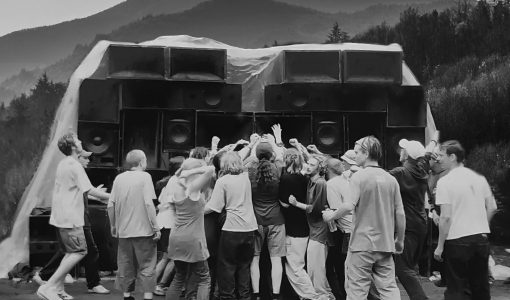
The question of the political power of art runs through the 20th and 21st centuries. But where is political art today? What we are radically asking is “where” it is, in all respects. What practices is it present in? What theories is it defined in? In what situations is it useful to us?
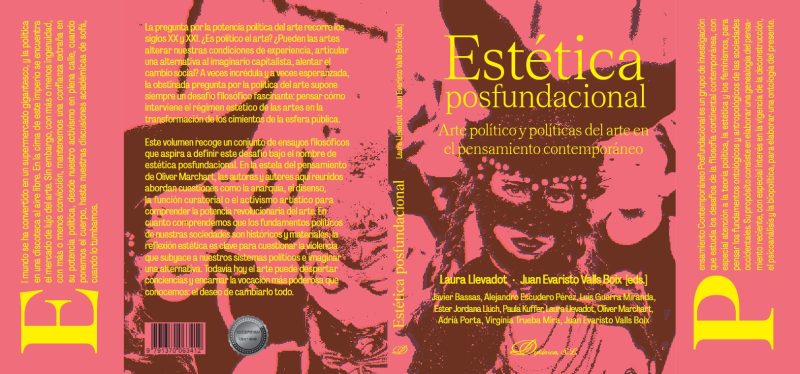
The multi-author publication Estética posfundacional [Post-Foundational Aesthetics] (Dykinson, 2005) brings together a body of philosophical essays that seek to respond to these and other questions related to the notion of post-foundational aesthetics. In the wake of the ideas of Oliver Marchart, who will be present at the event, the contributing authors address issues such as anarchy, dissent, the curatorial function and artistic activism, in an effort to comprehend art’s revolutionary power. As we understand that the political foundations of our societies are historical and material, aesthetic reflection becomes essential in questioning the underlying violence of political systems, while imagining alternatives.
The book presentation will feature the presence of various of the participating authors.
Oliver Marchart is an Austrian political philosopher and sociologist who is internationally recognised for his research in social theory, post-Marxism, post-structuralism and social movements. His books have given rise to far-reaching debate in many fields, as in the case of Post-Foundational Political Thought (Edinburgh University Press, 2007) and Conflictual Aesthetics (Sternberg Press, 2019), translated into Spanish by FCE and Ned Ediciones, respectively.
Laura Llevadot is a Professor in the Faculty of Philosophy of the University of Barcelona, and lead researcher in the research group Post-Foundational Contemporary Thought.
Juan Evaristo Valls Boix is a writer and Professor of the Philosophy of Culture at the Universidad Complutense de Madrid. He has a PhD in Contemporary Philosophy and Literary Theory, and is member of the research groups Post-Foundational Contemporary Thought and Estética Contemporánea. His research engages laziness and the rejection of work in late capitalism, with special attention to the politics of affects and contemporary French philosophy. His publications include the essays Giorgio Agamben. Política sin obra (Gedisa, 2020), Metafísica de la pereza (Ned Ediciones, 2022), Suely Rolnik. Descolonizar el inconsciente (Herder, 2024) and El derecho a las cosas bellas (Ariel, 2025).
Ester Jordana Lluch is Professor of Philosophy at the University of Zaragoza, with undergraduate degrees in Psychology (2001) and Philosophy (2008), and a PhD in Philosophy with a thesis on Michel Foucault (Être autrement. El ser como transformación en Michel Foucault, 2017). Her research is focused on the relations between politics, aesthetics and contemporary critical thought.
Xavier Bassas has a PhD in French Language and Philosophy from Paris-Sorbonne University and from the University of Barcelona, where he is a professor in French Studies. He is a translator and editor of various works in French theory (Marion, Derrida, Rancière, Malabou and others), and has recently written a monograph on Rancière (Ensayar la igualdad, Gedisa) as well as a dialogue with him on the politics of language (El litigio de las palabras, Ned Ediciones; in French, Les Mots et les Torts, La fabrique éditions). He is editor-in-chief of the book collection Pensamiento Atiempo for Casus Belli Ediciones.
Adrià Porta is a pre-doctoral researcher in the Faculty of Philosophy of the University of Barcelona. He is currently writing a thesis that compares the concept of the void in the work of four thinkers in post-foundational political philosophy: Lefort, Laclau, Badiou and Rancière.
Virginia Trueba is Full Professor in the Faculty of Philology and Communication of the University of Barcelona (UB), where she teaches in the Hispanic Philology and Literary Studies degree programmes, and in the master in Literary Theory and Comparative Literature. In recent years she has focused her research on the relationship between poetry and the arts in contemporary thought. She is co-editor of the journal Aurora, dedicated to the ideas of María Zambrano, and is member of the GLiCiArt (UB) research group on literature, cinema and other artistic languages.
Dates
10.01.2026 | 11:00-13:00
Category
Public Programme
Meeting point
Museu Tàpies
Date
10.01.2026
Time
11 am
Length
1 h 30 min
Price
Free