Following the Sun. Uncovering the Gaze
In ‘El joc de saber mirar’ [The Game of Knowing How to Look], a text published in January 1967 in Cavall Fort magazine for children and young people, Antoni Tàpies invited his readers to practise looking with an ‘open heart’ to gain deeper understanding of what is around us. The artist insisted on the need for a trained gaze to see beyond the immediate: a gaze able to broaden our ‘field of vision’ and therefore ‘our knowledge’.
‘Look, look closely! And let yourself be completely carried away by all the echoes within you of what your eyes give you . . . It’s a game. But playing it doesn’t mean doing things just for the sake of it . . . Playing, playing, we make our spirit grow, we broaden our field of vision, our knowledge. Playing, playing, we say things and listen to them, we awaken what was asleep, we help those who do not know how or have had their eyes covered to see.’
For Tàpies, this game involved an awakening of awareness that not only allowed a deeper experience of the work of art, but also transformed our relationship with everyday objects, and ultimately the very experience of living.
The controversy over his work Mitjó [Sock] years later can be interpreted in this sense, as a paradigmatic case of corruption of vision: a vision conditioned by cultural hierarchies, class prejudices, notions of taste and contingent political readings. Initially intended for the Oval Room of the Museu Nacional d’Art de Catalunya in 1991, the piece was rejected by the museum board and the culture department of the Catalan government. Years later, the artist decided to finally make it—on a smaller scale—and install it on the roof of the Fundació Antoni Tàpies, as it was then called.
With this gesture he highlighted something apparently insignificant—a sock with a hole in it—and reaffirmed his irreverent attitude towards the dominant criteria for legitimacy at the time. If to some the work symbolised something unworthy of representing Catalan culture, for others it opened up the possibility of a less normative view, able to recognise the poetic and political density of the everyday. The debate concerned not just the work of art, but also the ways of inhabiting a museum and the expectations projected onto it by public opinion.
How many ways are there of inhabiting an arts institution? Who establishes them? Which practices, bodies or sensibilities fit into it, and which are excluded? Like this the case of Mitjó came to symbolise thinking how far the institutional—and also our own—view can be expanded or, on the contrary, is limited by often invisible conventions.
In taking up these questions, the third edition of Following the Sun proposes seeing the museum as a porous space, filled with tensions, relations and possibilities. Taking inspiration from that ‘game of knowing how to look’, the series proposed training the perception with the aim of broadening our view to turn it into listening and shared experience.
Taking Mitjó as a starting point does not mean turning it into a subject, but into an attitude: looking beyond the immediate appearance, recognising the symbolic potential of the everyday and teasing out imaginary threads to detect their echoes outside the institution. Following the solar rhythm that gives the series its name, the guest performances go beyond conventional formats for production and reception to try out other ways of being in the museum: practices that are constructed out of friction, contact and presence, and that bring into play different ways of perceiving, listening and sharing the space.
Thus, the word made flesh guides the route through the innards of the museum, the sounds that do not sound open up the possibility of a measured score and matter is proposed as an active force with the possibility of agency. With its eyes uncovered, the audience becomes part of a collective ritual in several acts, a serious game which, from the museum roof terrace, echoes through new spaces yet to be imagined.
Carolina Ciuti
The third edition of the Following the Sun series is programmed and curated by Carolina Ciuti.
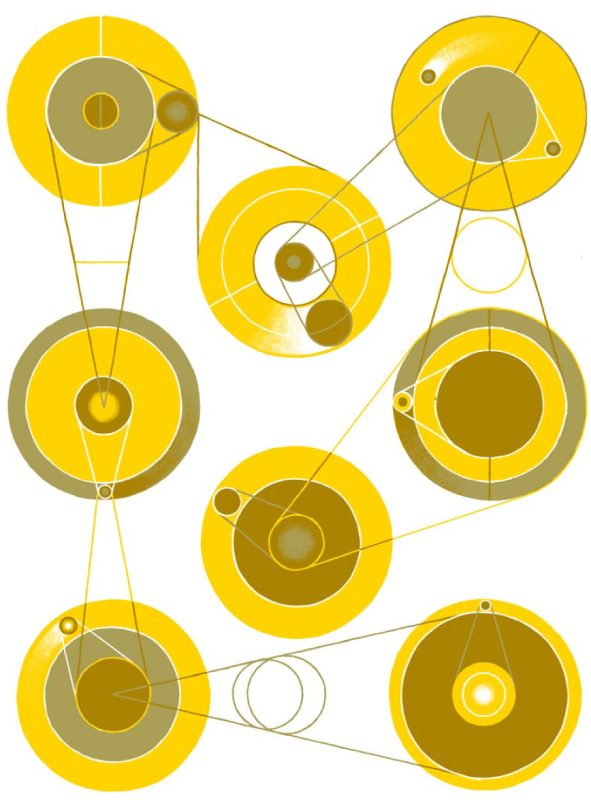
The graphic design of the programme and the calendar for solar navigation are the work of designers Ignasi Ayats and Ana Habash, while the illustrations are by Eduard Sales.
Programmed Sessions:
· Saturday 21 March, 2026, at 12 pm – blanca arias
· Saturday 18 April, 2026, at 12 pm – Laura Llaneli
· Saturday 16 May, 2026, at 12 pm – Blanca Tolsá i Albert Tarrats
· Friday 19 June, 2026, at 7 pm – Raquel G. Ibáñez
· Friday 19 September, 2026, at 7 pm – Anna Irina Russell
· Saturday 17 October, 2026, at 12 pm – rae teitelbaum
· Saturday 21 November, 2026, at 12 pm – Mireia Molina Costa
· Saturday 19 December, 2026, at 12 pm – Ariadna Guiteras
Carolina Ciuti (Pistoia, 1990) is a contemporary art curator and researcher in the visual arts field. A graduate in History of Art from the University of Florence and with a master’s degree in Contemporary Art, her curating practice explores the notion of time from cultural, political, economic and social points of view.
She currently edits the art journal exibart.es, and is a member of the team that is to represent Spain at the next Venice Art Biennale, as assistant curator. Alongside this, she works with the KBr Fundación MAPFRE photography centre in Barcelona as curator of the KBr Flama project, focused on supporting and promoting emerging artists, and runs independent curating projects in Spain and Italy.
Until 2022 she was artistic director of the LOOP Barcelona creative video festival, where she curated or produced exhibitions, film seasons and performances by artists like Basim Magdy, Agnes Meyer-Brandis, Regina de Miguel, Aleksandra Mir, Steina & Woody Vasulka and Anton Vidokle. She has curated exhibitions at international institutions and events including Westbund Art & Design, Shanghai; Festival 8 albe, Noto, Sicily; KBr Fundación MAPFRE, Filmoteca de Catalunya, Fabra i Coats – Centre d’Art Contemporani, Fundació Antoni Tàpies, Fundació Suñol and MACBA, Barcelona; and FIAC, Paris, among others.
She edited the publications Before the Name: A Book on an Itinerant Performance Project (RAM Editions, 2018) and I Have a Friend Who Knows Someone Who Bought a Video, Once (Mousse Publishing, 2016). She regularly writes for the journal La Maleta de Portbou.
Dates
From 21.03.2026 to 12.12.2026
Meeting point
Museu Tàpies (Carrer Aragó, 255, Barcelona, Catalonia)


