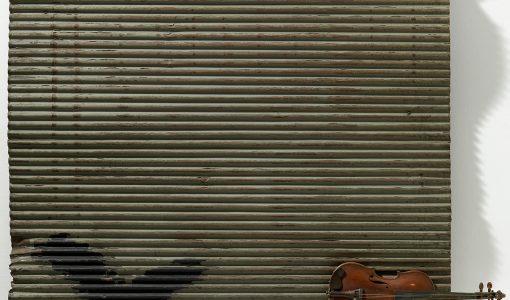
International Symposium “Primitive Images, Modern Dreams: Tàpies and Post-War Visual Culture”

As part of the exhibition Antoni Tàpies: The Imagination of the World, the Museu Tàpies is organising an international symposium to explore the study of the image on the basis of its collection. This initiative is part of the museum’s ongoing line of research and aims to rethink the visual narratives that shape our collective imagination, paying special attention to the symbolic, aesthetic world view surrounding Antoni Tàpies’ work.
The symposium sets out from the body of work on exhibition, made up of works by Tàpies from the forties and fifties, prior to his material period; pieces belonging to the artist’s private collection from non-Western cultures or by other artists in his context, and archive material—both belonging to the museum and acquired by it specifically to prepare this exhibition—related to the popular imagination of the day.
On the basis of these materials, the symposium concentrates on three subject areas that can be followed throughout the exhibition: primitivism, psychoanalysis and popular culture. These areas allow us to place Tàpies’ artistic output in the context of a post-war Barcelona deeply marked by social, political and cultural changes, and to connect it with international avant-garde movements. At the same time, this encounter sets out to explore other aspects, such as the way Tàpies approached vernacular traditions and ancestral practices, the impact of psychoanalytic thought on his work as a tool for addressing psychological concerns typical of an era, and the dialogue between academic art and popular knowledge as forms of resistance and radical expression.
The symposium stands out for its interdisciplinary approach, incorporating philosophy and psychoanalysis to address images not only as aesthetic forms but also as instruments of thought and symbolic construction. Its ultimate goal is to offer an updated, critical reading of Tàpies’ work, opening up spaces for discussion of the image, the historical narrative and cultural memory.
Programme of the symposium
Wednesday, 3 December 2025
· 6 pm. Welcome and presentation by the Museu Tàpies
· 6.10 pm. Talk: ‘The Material Imagination’, by Emmanuel Alloa
· 6.50 pm. Talk: ‘A Visionary Context: Spiritualism, Clairvoyance and the Unconscious’, by Andrea Graus Ferrer
· 7.30 pm. Break
· 7.40 pm. Talk: ‘The Origin and Context of primitivism in Antoni Tàpies’, by Estela Ocampo
· 8.20 pm. Round table and debate moderated by the Museu Tàpies
· 9 pm. Closing
Thursday, 4 December 2025
· 6 pm. Welcome and presentation by the Museu Tàpies
· 6.10 pm. Talk: ‘Imagination, imagined, imaginary’, by Chiara Boticci (online)
· 6.50 pm. Talk: ‘Club 49, a Window on the World’, by Muriel Gómez
· 7.30 pm Break
· 7.40 pm Talk: ‘Swing and Modernity: Jazz in postwar Barcelona’ by Jordi Pujol Baulenas
· 8.20 pm. Round table and debate moderated by the Museu Tàpies
· 9 pm. Close with ‘Echoes of Club 49’, by the Carlos Falanga Trio
Speakers
Emmanuel Alloa. Professor of Aesthetics and Philosophy at the University of Freiburg (Switzerland). A researcher at NCCR eikones, he has lectured at Paris 8 University and been a guest lecturer at the universities of Weimar (Germany), Morelia (Mexico), Belo Horizonte (Brazil), Shanghai (China) and Berkeley, Columbia and Yale (United States).
Alloa has published a dozen books on contemporary philosophy, phenomenology and the relations between aesthetics and politics. His work has been translated into English, German, French, Spanish, Portuguese and Chinese. Highlights among his publications in Spanish include: La resistencia de lo sensible (2009), ¿Cómo (no) leer las imágenes? (2019), La imagen diáfana (2021), Pensar la imagen I & II (2020 and 2022) and Repartos de la perspectiva (2024). His research work has won several awards, including the Latsis Award in 2016 and the Aby Warburg Award in 2019.
Chiara Bottici. An Italian philosopher and writer, she lives and works in New York. She holds a chair in Philosophy in the Philosophy department of the New School for Social Research, where she lectures, among other things, on the thought of Hannah Arendt and Ágnes Heller. As well as lecturing in political philosophy and aesthetics, at the same institution she has founded and run the Gender and Sexualities Studies Institute.
She has written, among other things, Filosofía del mito político (Bollati Boringhieri, 2012), The Myth of the Clash of Civilizations (2010, with Benoît Challand), Imagining Europe: Myth, Memory and Identity (2013, with Benoît Challand), Manifest anarcafeminista (Laterza, 2022), Cap submissió: El feminisme com a crítica de l’ordre social (2023), Mitologia feminista (Castelvecchi, 2022) and La política de la imaginació (Castelvecchi, 2023). Her work has been translated into a dozen foreign languages.
Carlos Falanga. Born in Buenos Aires (Argentina), at a very early age he started learning drums with Roberto Cesari Jr. At the age of 22 he decided to move to Barcelona, where he continued his study of harmony and the piano at the Taller de Músics, and of the drums with the great Aldo Caviglia. He subsequently graduated from the Barcelona Conservatory (ESMUC), where he studied with Jo Krause and David Xirgu.
Since 2002 he has played an active part in the Catalan music scene, performing in clubs and festivals all over Europe, Asia and the Americas, with a range of Spanish musicians and artists including Jorge Rossy, Marco Mezquida, Amparo Sanchez, Carme Canela, Horacio Fumero, Bill McHenry, Fredrik Carlquist, Guillermo Klein and the Orquestra Simfònica del Liceu, among others. He has released two albums under his own name: Gran Coral (Underpool) and Quasar (Fresh Sound New Talent), and with his experimental project IHHH he has made several recordings and performed at many festivals, including Sónar Festival and Keroxen.
Muriel Gómez. She has a doctorate in the History of Art from the University of Zaragoza. She is currently an associate lecturer and vice-dean for Alliances, Community and Culture in Art and Humanities Studies at the Universitat Oberta de Catalunya (UOC). A member of the SEC (Society, State and Culture) history research group, her research focuses on the analysis of processes of rupture and continuity in Catalan artistic modernity between the pre-war and post-war periods. Her main areas of study include the links between ADLAN and Club 49, and the figures of Joan Miró and the sculptor Eudald Serra.
Andrea Graus Ferrer. Ramón y Cajal researcher at the Institució Milà i Fontanals d’Investigació en Humanitats at the CSIC. With a doctorate in the History of Science from the UAB, she worked at the Centre Alexandre Koyré at the CNRS in Paris and at the University of Anvers (Belgium) for six years. The author of Ciència i espiritisme a Espanya (1880-1930) (Comares, 2019), she has published work on the history of psychic research with mediums, hypnosis and mystical phenomena in the 19th and early 20th centuries. Her current line of research focuses on the history of gifted children and child talent in contemporary Europe, the subject of her next book. She curated the exhibition Gifted Children: Fame, Science and Politics (Biblioteca de Catalunya, 2024).
Estela Ocampo. She was a tenured lecturer at the University of Barcelona from 1987 and at the Pompeu Fabra University in Barcelona from 1987 until her retirement in September 2021. Academic secretary at the Pompeu Fabra University’s Institut de Cultura (2000–2008). Director of the Pompeu Fabra University’s Institut Universitari de Cultura (2008–2014), She is currently director and lead researcher at CIAP, the Research Centre for Primitive Art and Primitivism at the Pompeu Fabra University. She has carried out research projects funded by the Spanish ministry of education and science into primitive art between 1997 and 2003, and into primitivism and modern art between 2007 and 2016.
She has published numerous articles in Spanish and international journals. Her most recent books are: El Fetitxe en el Museu, (Madrid, 2011), Primitivisme a Europa i Amèrica, (Barcelona, 2017) and Traços. Pintura aborigen australiana: tradició i contemporaneïtat (Barcelona, 2022), among others. She has given numerous lectures and seminars in Spain and abroad. She has curated several exhibitions, the last being Strokes. Australian Aboriginal Painting: Tradition and Contemporaneity (Museu Etnològic i de les Cultures del Món, December 2021 – June 2022).
Jordi Pujol Baulenas. Born in Barcelona in 1953, in 1983 he founded the music label Fresh Sound Records, devoted to jazz, after having worked as a textile designer in Lyon and Barcelona. In the course of his career, he has recovered historic recordings like the concert by Louis Armstrong in Windsor (1955), and, with the label Fresh Sound New Talent, recorded the debut albums by artists like Brad Mehldau, Robert Glasper, Ambrose Akinmusire and Kurt Rosenwinkel, as well as numerous local musicians. The winner of awards from the Académie du Jazz and the Académie Charles Cros, he has featured in articles and interviews in media including Down Beat, Jazz Magazine, The New York Times and Los Angeles Times. He is the author of the book Jazz a Barcelona 1920-1965, winner of the Ciutat de Barcelona Award in 2006.
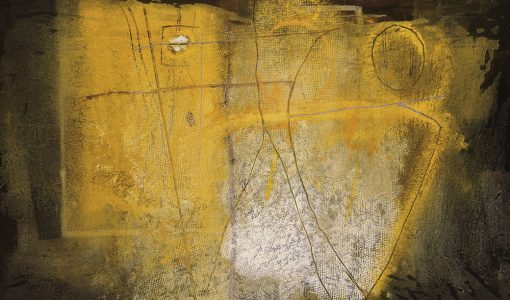
[Imagen: Antoni Tàpies, Gossos (Dogs), 1948. Col·lecció particular, Barcelona © Comissió Tàpies / VEGAP, 2025]
Dates
03.12.2025-04.12.2025
Category
Public Programme
Sessions
03 December 2025
04 December 2025
Venue
Auditorium of Museu Tàpies (Carrer Aragó, 255, Barcelona, Catalonia)
Time
6 pm
Length
3 h
Price
· €3 for one session
· €5 for two sessions
· Free for students
Programme