International symposium ‘The Wall and the City: Visual Devices of Modernity’
The International Symposium The Wall and the City: Visual Devices of Modernity is conceptually related to Antoni Tàpies: The Perpetual Movement of the Wall, an exhibition currently being shown at Museu Tàpies, curated by Imma Prieto and Pablo Allepuz, and exploring the artist’s work through his contexts and exhibition modes. It focuses on four solo shows from the 1950s, which were characterised by groups of work and highly diverse display solutions, making it possible to situate Tàpies’ production in relation to broader debates on modern architecture, design, industry, urban space and ways of life in the period.
Drawing from this conceptual framework, the international symposium The Wall and the City: Visual Devices of Modernity proposes a critical reading of modernity through the material and visual devices that made it possible: walls, facades, pavements, shop windows, posters, exhibition structures and domestic spaces. These apparently functional features become active agents of mediation between art, design, architecture and perceptive experience, given that matter, light, visual display and the arrangement of objects influence in aesthetic perception and define new ways of seeing, inhabiting and understanding the city.
In the context of European reconstruction after the Second World War, and during the postwar and cultural isolation of Francoism in Spain, the exhibition space and urban landscapes worked as laboratories for modernity. Museums, pavilions, shop windows and housing became experimental spaces where architecture, design and display gave rise to specific forms of perception, setting apart the visual and urban sensibility of the postwar.
In Barcelona, figures like Antoni Tàpies, Josep Antoni Coderch, Antoni de Moragas Gallissà, Oriol Bohigas, Ricard Giralt Miracle and America Sanchez would come to postulate a common syntax: a contained, artisanal modernity, with material density and manual gesture, articulating architecture, design and visual display. Their practice would not only define visual culture, but also a model of display that conditioned the aesthetic perception of space and the object.
This symposium analyses these mechanisms as active practices of discourse and perception shaping imagined models of community, memory and the relationship between body and architecture. It looks back at exhibition, architectural and graphic languages of the 1950s and 1960s, querying their currency: what remains nowadays of that way of conceiving walls, homes or the city itself as spaces for thought, resistance and perception? What are the continuities or ruptures between the visual devices of modernity and current practices in museography and urban design?
In this symposium, Barcelona is set into dialogue with other centres of modernity—Milan, Paris, Brussels, Zurich and London—tracing out a comparative cartography of possible modernities, examining how material and visual discourses built a European idea of modernity. This revision makes it possible to think of the contemporary museum and city as spaces for critique, experimentation and aesthetic experience, where the memory of modern display continues to be a strategy of thought and perception.
Researchers, artists, architects, designers and curatorial professionals were invited to submit proposals that address these issues from critical, historical or contemporary perspectives, and with interdisciplinary approaches. The call for papers promoted by the Antoni Tàpies Chair – UPF of Contemporary Art and Thought broadens and deepens the curatorial proposal of the exhibition, inviting critical investigation of these material and symbolic infrastructures from diverse historical and theoretical perspectives, taking as a starting point the exhibition that can currently be visited at the Tàpies Museum. Beyond the exhibition narrative, the symposium opens a space for academic debate to analyze how these devices have shaped aesthetic perception and experience, as well as the social and political dynamics inscribed in the modern city.
PROGRAMME
Wednesday 27 May 2026
- 6 pm. Welcome and presentation, Museu Tàpies
- 6.10 pm. Lecture ‘The Wall We Are: Tàpies, Space and Work’, by Federico Ferrari
- 6.50 pm. Lecture ‘Surroundings and Their Influence’, by Xavi Ceerre
- 7.20 pm. Pause
- 7.30 pm. Lecture ‘Beyond the Wall’, by Carlos Bunga
- 8.10 pm. Discussion and debate
- 8.30 pm. Closing
Thursday 28 May 2026
- 6 pm. Welcome and presentation, Museu Tàpies
- 6.10 pm. Lecture ‘Extramural: of the Silhouette of the Shadow of the Reflection of the Image’, by Juan José Lahuerta
- 6.50 pm. Lecture ‘From Being to Nothingness: Object, Body and Space in Contemporary Performance Art’, by Lyu Wen
- 7.20 pm. Pausa
- 7.30 pm. Lecture ‘The Miró Model: Ephemeral Exhibition as Artistic Practice’, by Jordana Mendelson
- 8.10 pm. Discussion and debate
- 8.30 pm. Closing
Friday 29 May 2026
- 6 pm. Welcome and presentation, Museu Tàpies
- 6.10 pm. Lecture ‘The Scars of War’, by Beatriz Colomina
- 6.50 pm. Lecture ‘Tàpies and Art Criticism’, by Victoria Combalía
- 7.30 pm. Pause
- 7.40 pm. Discussion and debate
- 8 pm. Closing sound action, ‘Active Void. Reflections on Nothingness’, by Rasheed Jalloul
- 8.30 pm. Final
SPEAKERS
Carlos Bunga
Carlos Bunga creates work oriented towards process—installations, performance, video, drawing, sculpture, painting—referring to his immediate architectural surroundings, intervening in them. While using ordinary, non-descript materials, his work implies conceptual complexity, as derived from the interrelation between doing and undoing, between undoing and starting over, between research and experimentation.
Bunga first attracted international attention with his work for the contemporary art biennial Manifesta 5 in San Sebastian (2004). Since then, he has had individual exhibitions at CAM Fundação Gulbenkian, Lisbon (2025); MNCARS, Madrid (2022); Secession, Vienna (2021); Whitechapel, London (2020); MAAT, Lisbon (2019); Haus Konstruktiv Museum, Zurich (2015); MACBA, Barcelona (2015); Hammer Museum, Los Angeles (2011); and the Pinacoteca de São Paulo (2010), among others.
Xavi Ceerre
Ceerre’s pictorial practice has a processual character, exploring the physicality of gesture, error and material, with a special interest registering collective subconscious in public space, and in the tensions between urban planning and subversive forms.
He graduated in Graphic Design from Escola Llotja and has an MA in Painting from UPV/EHU, as well as an MA in Teacher Training (UB). He further broadened his education at the School of Visual Arts, New York, and Gerrit Rietveld Academie, Amsterdam.
Ceerre has regularly shown at Galeria Carles Taché since 2021, participating in art fairs like Art-o-rama, Estampa and CAN. He has done residencies at BilbaoArte, Fabra i Coats and Piramidón, among others. His work is found in various public and private collections.
Beatriz Colomina
Howard Crosby Butler Professor of the History of Architecture at Princeton University, Colomina is head of the doctoral programme at the School of Architecture and founding director of the university’s interdisciplinary programme Media and Modernity.
Recent book publications include Sick Architecture (MIT Press, 2025) and We the Bacteria: Notes Toward Biotic Architecture (Lars Müller, 2025). With Mark Wigley she recently co-curated the exhibition We the Bacteria: Notes Toward Biotic Architecture at Triennale Milano (2025) and The Other Side of the Hill at the Venice Biennale (2025).
Victoria Combalía
Combalía has a doctorate from the University of Barcelona, where she has been Professor of Art History since 1974. She was guest researcher at The Institute of Fine Arts, New York, from 1979 to 1981. She has organised more than sixty exhibitions, including Joan Brossa, 1941-1991 (1991), Veure Miró. La irradiació de Miró en l’art espanyol (1993), Com ens veiem. Imatges i arquetips femenins (1996), Kandinsky. Obres procedents del Centre Pompidou (1996), Sean Scully (2005), Dora Maar, malgrat Picasso (2014) and Dones surrealistes (2017). She is a specialist in Joan Miró and the biographer of Dora Maar.
Combalía has published Estudios sobre Picasso (1981), Antoni Tàpies (1984), Picasso-Miró, mirades creuades (1998), Amazonas con pincel (2006), Dora Maar, més enllà de Picasso (2013), Musas, mecenas y amantes (2016) and Ver para vivir. Memorias (2024), among others. She was the director of Centre Cultural Tecla Sala and was artistic consultant to the Madrid Region. In 2003 she was named Chevalier des Arts et des Lettres, and is current president of the Dora Maar Committee.
Federico Ferrari
An Italian philosopher and aesthetician, Ferrari is Professor of Aesthetics at the Accademia di Belle Arti di Brera. In 2020 he founded Antinomie with Andrea Cortellessa and Riccardo Venturi, a website dedicated to the relationship between images and words. In 2025 he was a driving force behind the creation of the Centro di storia e teoria dell’arte (CeSTA), based at the Accademia di Brera. He has published various books in Italy and internationally, centring on communitarian questions within disaffected social structures in postmodern civilization, as well as on artistic experience, in its ambiguous tension between the aspiration for a different world and its reduction into a luxury commodity in a speculative market.
His book publications include La comunità errante (1997), Nudità (1999), Lo spazio critico (2004), Costellazioni (2006), Sub specie aeternitatis (2008), Il re è nudo (2011), Arte essenziale (2011), L’insieme vuoto (2013), L’anarca (2014; 2nd ed. 2023), Visioni (2016), Oscillazioni (2016), Il silenzio dell’arte (2021), L’antinomia critica (2023), Ritratti (2025) and, with Jean-Luc Nancy, La pelle delle immagini (2003), Iconografia dell’autore (2006), La fin des fins (2015) and Estasi (2022).
Rasheed Jalloul
Jalloul is a Lebanese architect, artist, composer and researcher based in Barcelona. His practice moves between architecture, sound and language, understanding them as interdependent systems through which space is articulated. His methodology works like a political Casimir effect, where voids produced by calamity reorganise perceptive and mnemonic conditions. Through this notion of an active void, Jalloul addresses absence as a conditioning field, from which form emerges through processes of subtraction and fluctuation, challenging colonial epistemologies of body and space.
Currently Jalloul is a resident at Centre d’Arts Santa Mònica, where he is researching spatial mediation. His work has been presented at MACBA, Kampnagel, Festival Sâlmon, RCR Arquitectes and the Fundació Enric Miralles, among others.
Juan José Lahuerta
Lahuerta has been Professor of Art History at ETSAB – Barcelona School of Architecture, and has taught at Università Iuav di Venezia and New York University, among others. He was conservator of the Picasso Museum Barcelona and head of collections at the Museu Nacional d’Art de Catalunya. Recent publications include Religious Painting: Picasso and Max Von Moos (2015), Marginalia: Aby Warburg, Carl Einstein (2015), Photography or Life: Popular Mies (2015), On Loos, Ornament, and Crime (2015), Antoni Gaudí: Ornament, Fire, and Ashes (2016) and Arte en la época del infierno (2022).
He has curated exhibitions such as Picasso. Romànic (MNAC, Barcelona, with the collaboration of Musée Picasso, Paris, 2015), Gaudí (MNAC, Barcelona and Musée d’Orsay, Paris, 2022) and Julio González. Ser Artista (IVAM, Valencia, 2023), and is the author of their respective catalogue essays. Lahuerta is member of the editorial board of Casabella (Milan) and founder and director of the publisher Mudito & Co (Barcelona, New York, Venice).
Jordana Mendelson
Jordana Mendelson is Associate Professor in the Department of Spanish and Portuguese at New York University, where from 2020 to 2026 she has directed Espacio de Culturas, a centre focused on developing events and programmes related to Spain, the Iberian Peninsula and America. Her research centres on visual, exhibited and printed culture in Spain during the 1930s.
She is the author of Documenting Spain: Artists, Exhibition Culture and the Modern Nation, 1929-1939 (Penn State UP, 2005), co-editor of Postcards: Ephemeral Histories of Modernity (Penn State UP, 2010) and curator of the exhibitions Revistas y Guerra 1936-1939 (Madrid, Museo Reina Sofía, 2007) and Encounters with the 1930s (Madrid, Museo Reina Sofía, 2013). She is also co-editor of the Journal of Spanish Cultural Studies. Mendelson is currently working on a publication with the provisional title Paper Routes: The Power of Design in 20th-Century Spain.
Lyu Wen
An interdisciplinary artist and researcher, Lyu Wen is doing a PhD in the Department of Humanities at Pompeu Fabra University. Her work explores the intersection between performance art, digital media and the philosophy of the Kyoto School.
Working in performance, video, installation and painting, she develops an approach based on a practice that feeds her research. Her current projects explore the ways everyday actions, such as walking and sitting, might be transformed into corporeal practices of sustained attention and awareness.
With the collaboration and participation of the Antoni Tàpies – UPF Chair of Contemporary Art and Thought.
Within the framework of Barcelona 2026, International Capital of Architecture.
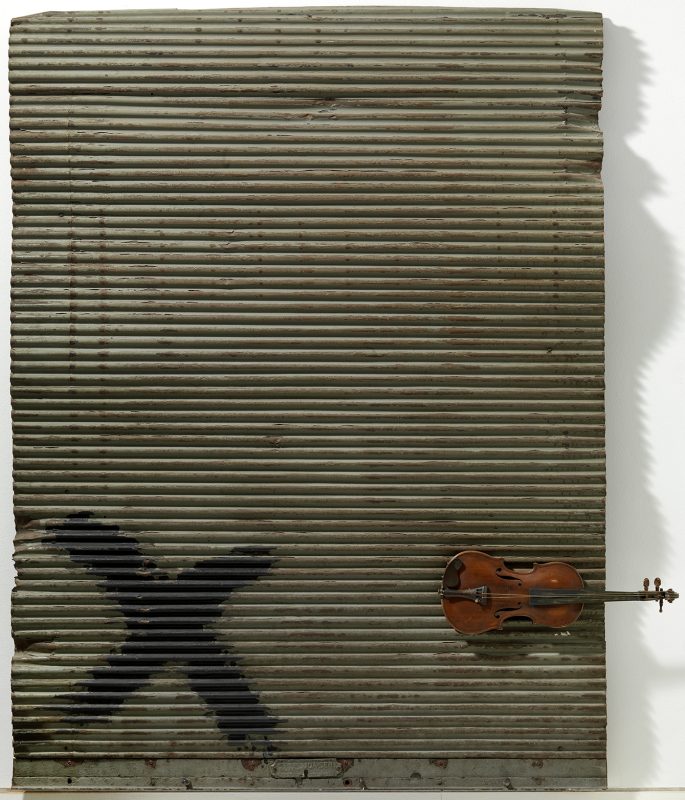
[Image: Antoni Tàpies, Porta metàl·lica i violí, 1956. Museu Tàpies Collection, Barcelona. © Comissió Tàpies / VEGAP, 2026.]
Dates
27.05.2026-29.05.2026
Category
Public Programme
Meeting point
Museu Tàpies
Related
Dates
27, 28 and 29 May
Time
6 pm
Length
2,5 hours
Place
Museu Tàpies (c. Aragó, 255, Barcelona)
Price
4 €, one session
9 €, all sessions
Free for students
Programa